The Chivalry Research Assistant

Research. Correlate.
Educate. Compare. Decide.

Compare a bloodstock sale group, research a mating or examine a horse’s racing and workout history. Follow the records, compare the evidence and ask the next question.

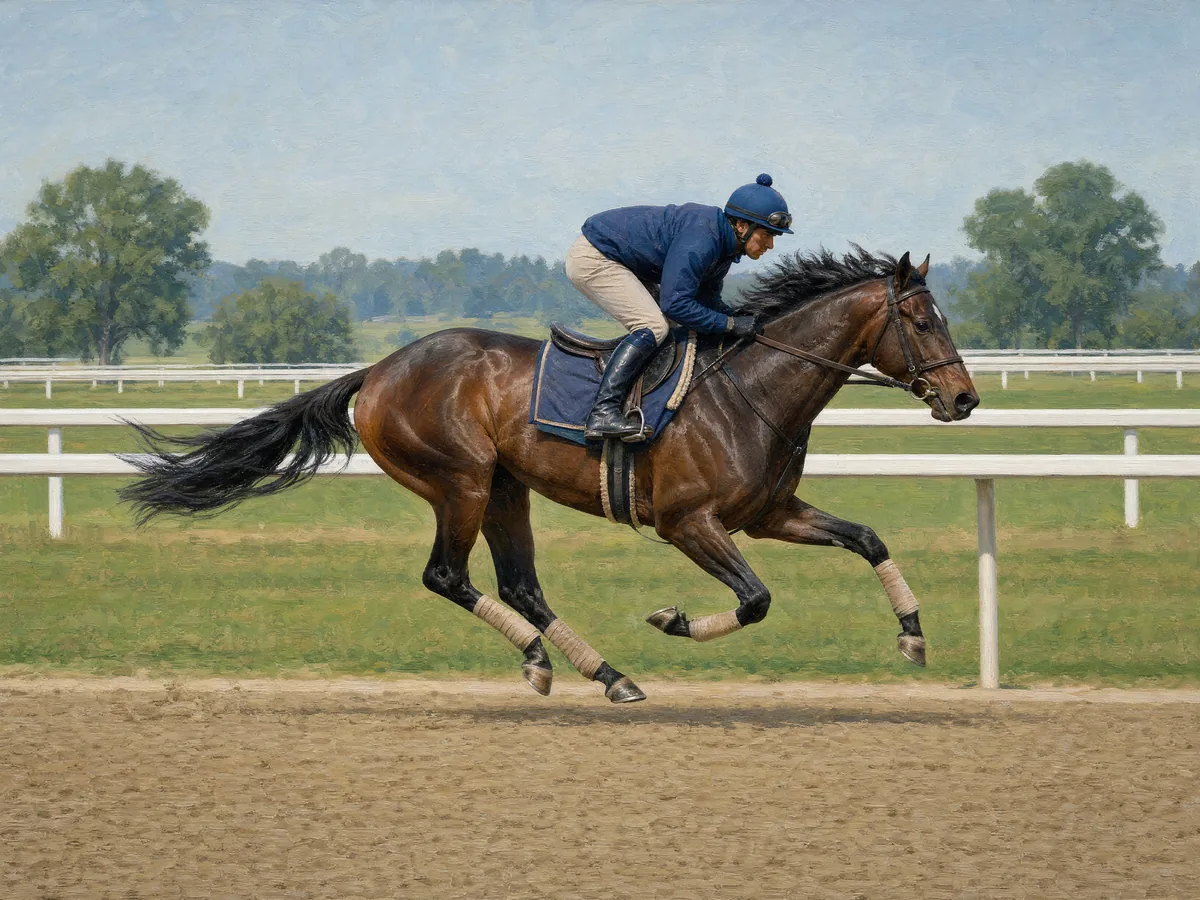
Oil painting of a racehorse and jockey in front of a historic grandstand
ChivalryAI2020–2022 purchases
Recorded lifetime results

How did the Quality Road fillies perform?

Recorded runners
7
Starts
60
Wins
7
Follow the conversation
From 8 recorded purchases at two-year-old-in-training sales in 2020–2022.Sales history & race history

One question, taken further

Follow the thread.

Follow a cohort into its racing record, benchmark the result, then test the conclusion within purchase-price bands.

The starting point

Define the group.

Set the sire, sex, sale classification, purchase result, and sale years.

The question

How have fillies by Quality Road sold at two-year-old sales from 2020–2022 performed on the racetrack? Show their lifetime racing results.

Positive-price purchases at 2020–2022 two-year-old-in-training sales. Racing results describe the recorded lifetime, rather than only the sale years.

The first answer

Read the record.

See the horses behind the totals, including recorded starts, earnings, and the last recorded race.

The recorded lifetime results

Lifetime racing results
Horse (ID)BornDamLifetime recordLifetime earningsLast recorded race
Urban (298161)2019Moonlight Sky9–1–2–2$97,488Oct. 1, 2022
Ali Alley (265361)2019Madame Pele6–0–2–2$81,680Nov. 8, 2022
Get Your Kicks (60421)2020Cali Thirty Seven7–2–0–0$74,145May 29, 2024
Athenais (462863)2019Tarkia20–1–4–3$49,270June 28, 2024
Princess of Ocala (304359)2018My Catriona16–3–5–4$19,690Feb. 25, 2022
Herecomesangelina (85641)2019Collide1–0–0–0$1,720Feb. 18, 2022
La Voie (108577)2020Debonnaire (GB)1–0–0–0$340May 6, 2023
Husk (618491)2020Sam’s SisterNo recorded starts$0—
Total60–7–13–11$324,333
Read the complete answer and qualifying purchases

The next questions

Compare.
Then question.

Compare Into Mischief and Curlin, then ask whether price bands and leading earners change the conclusion.

The benchmark

Side-by-side comparison
MetricQuality RoadInto MischiefCurlin
Fillies purchased8369
Total purchase prices$1,130,000$8,232,000$3,490,000
Average purchase price$141,250$228,667$387,778
Median purchase price$78,500$145,000$430,000
Purchase-price range$7,000–$375,000$15,000–$750,000$60,000–$670,000
Recorded runners7 (87.5%)33 (91.7%)8 (88.9%)
Winners / all purchased4 (50.0%)20 (55.6%)4 (44.4%)
Lifetime starts–wins–seconds–thirds60–7–13–11274–31–33–2752–8–4–4
Wins per start11.7%11.3%15.4%
Total lifetime earnings$324,333$1,647,984$707,295
Average earnings per purchased filly$40,542$45,777$78,588
Median lifetime earnings$34,480$36,044$18,208
Stakes winners / all purchased01 (2.8%)2 (22.2%)
Graded-stakes winners010
Stakes wins012
Stakes winners or placed horses¹2 (25.0%)3 (8.3%)2 (22.2%)
Lifetime earnings ÷ purchase prices28.7%20.0%20.3%
Fillies earning at least their purchase price1 (12.5%)4 (11.1%)0

Gross purse earnings divided by purchase price is not investment ROI. The third turn examines the small samples and purchase mix behind the overall comparison.

Read the price-band comparison

The way to a useful answer

The detail you bring
shapes the research.

The horse

Establish the identity.

A name, foaling year, sire, or dam helps distinguish the horse you mean.

The comparison

Set the boundaries.

Choose a sale group, family, date range, distance, or conditions you want to study.

The evidence

Follow the result.

Read the supporting records and ask which assumptions or sample differences could change the conclusion.

Try ChivalryAI

Bring your next question.

Put the Research Assistant to work on a horse, sale group or comparison of your own. Explore the records and ask the next question.

7-day free trial with a generous research allowance.

Explore the research

Read the answer.
Follow the question.

Open the complete saved responses, including every table, follow-up, and qualification. Their recorded scopes and source notes remain part of the answer.

01 · Sale to race

From purchases to performance.

Follow the 2020–2022 Quality Road sale group, compare Into Mischief and Curlin, then test the conclusion within purchase-price bands.

Read complete response

The question

How have fillies by Quality Road sold at two-year-old sales from 2020–2022 performed on the racetrack? Show their lifetime racing results.

Quality Road sales cohort and lifetime racing results

Quality Road fillies sold at 2YO sales, 2020–2022

Eight fillies had recorded purchases at two-year-old-in-training sales. Their lifetime results recorded in Chivalry total 60 starts, 7 wins and $324,333 in earnings.

  • 7 of 8 raced (87.5%), and 4 of 8 won (50%).
  • None became a stakes winner in the recorded lifetime results.
  • Urban was the leading earner and the only graded-stakes-placed runner, finishing second in the Grade 3 Sweet Life Stakes.
  • Average lifetime earnings were $40,542; median earnings were $34,480.
Lifetime racing results

Sorted by lifetime earnings. Record is starts–wins–seconds–thirds; these are all recorded lifetime starts, not just races during 2020–2022.

Lifetime racing results
Horse (ID)BornDamLifetime recordLifetime earningsLast recorded race
Urban (298161)2019Moonlight Sky9–1–2–2$97,488Oct. 1, 2022
Ali Alley (265361)2019Madame Pele6–0–2–2$81,680Nov. 8, 2022
Get Your Kicks (60421)2020Cali Thirty Seven7–2–0–0$74,145May 29, 2024
Athenais (462863)2019Tarkia20–1–4–3$49,270June 28, 2024
Princess of Ocala (304359)2018My Catriona16–3–5–4$19,690Feb. 25, 2022
Herecomesangelina (85641)2019Collide1–0–0–0$1,720Feb. 18, 2022
La Voie (108577)2020Debonnaire (GB)1–0–0–0$340May 6, 2023
Husk (618491)2020Sam’s SisterNo recorded starts$0—
Total60–7–13–11$324,333

All eight are female offspring of Quality Road.

Qualifying purchases
HorseSaleSale dateHipPurchaserPrice
UrbanFasig-Tipton MidAtlantic 2YOMay 17, 202146Solis/Litt$375,000
Ali AlleyOBS April 2YOApr. 22, 20211050Ben McElroy, Agent$260,000
Get Your KicksOBS April 2YOApr. 21, 2022227Bradley Thoroughbreds, Agent$300,000
AthenaisOBS April 2YOApr. 22, 2021296Marquee Bloodstock$110,000
Princess of OcalaOBS April 2YOJune 11, 2020171Andy Perez$7,000
HerecomesangelinaOBS April 2YOApr. 22, 2021647Rudy Rodriguez$20,000
La VoieOBS Summer 2YO & HORAJune 9, 2022797Cove Springs$47,000
HuskOBS Summer 2YO & HORAJune 9, 2022312Quality Bloodstock$11,000

Scope: “Sold” means a recorded purchase with a positive price at a 2YO-in-training sale. I excluded RNAs, withdrawals, $0 entries with purchaser “Out,” and two-year-olds sold at general breeding-stock/all-ages sales. All qualifying entries have sale phase/group 2YO and recorded result sold.

Source: Chivalry sales history, horse profiles and race history. Results reflect available database records; the last-recorded-race dates do not establish retirement or guarantee complete current racing coverage.

The question

How does that compare with Into Mischief and Curlin fillies sold at two-year-old sales in the same years? Compare purchase prices, lifetime racing performance, and stakes results side by side. Which group delivered the strongest racing results relative to purchase price?

Sire comparison and purchase-price-adjusted earnings

Quality Road delivered the strongest recorded racing earnings relative to purchase price. Curlin produced the highest average earnings and stakes-winner rate, while Into Mischief supplied the only graded-stakes winner.

I used the same scope as before: fillies purchased for a positive price at two-year-old-in-training sales in 2020–2022, excluding RNAs, withdrawals, buyers listed as “Not Sold,” and general mixed/breeding-stock sales. Each horse is counted once; racing results cover its recorded lifetime, not just 2020–2022.

Side-by-side comparison

Side-by-side comparison
MetricQuality RoadInto MischiefCurlin
Fillies purchased8369
Total purchase prices$1,130,000$8,232,000$3,490,000
Average purchase price$141,250$228,667$387,778
Median purchase price$78,500$145,000$430,000
Purchase-price range$7,000–$375,000$15,000–$750,000$60,000–$670,000
Recorded runners7 (87.5%)33 (91.7%)8 (88.9%)
Winners / all purchased4 (50.0%)20 (55.6%)4 (44.4%)
Lifetime starts–wins–seconds–thirds60–7–13–11274–31–33–2752–8–4–4
Wins per start11.7%11.3%15.4%
Total lifetime earnings$324,333$1,647,984$707,295
Average earnings per purchased filly$40,542$45,777$78,588
Median lifetime earnings$34,480$36,044$18,208
Stakes winners / all purchased01 (2.8%)2 (22.2%)
Graded-stakes winners010
Stakes wins012
Stakes winners or placed horses¹2 (25.0%)3 (8.3%)2 (22.2%)
Lifetime earnings ÷ purchase prices28.7%20.0%20.3%
Fillies earning at least their purchase price1 (12.5%)4 (11.1%)0

¹Unique horses that won or finished second/third in a stakes race; winners are not counted twice.

Stakes results and leading performers

Record below is starts–wins–seconds–thirds.

Stakes results and leading performers
SireHorse (ID)Purchase priceLifetime recordEarningsStakes achievement
Quality RoadUrban (298161)$375,0009–1–2–2$97,4882nd, G3 Sweet Life S.
Quality RoadAli Alley (265361)$260,0006–0–2–2$81,6802nd, Sunland Park Oaks
Into MischiefNaughty Gal (89188)$350,0005–2–0–0$152,785Won G3 Adirondack S.
Into MischiefLady Puchi (16982)$90,00021–2–4–1$208,0142nd, Searching S.; group’s leading earner
Into MischiefFast and Flirty (434036)$120,00011–1–2–1$130,9633rd, Cash Run S.
CurlinDistinctlypossible (162488)$670,00010–3–2–0$308,393Won Serena’s Song S.; 2nd, G1 Alcibiades S.
CurlinCurlin’s Catch (68604)$430,0009–2–1–1$146,543Won Suncoast S.; 3rd, Fury S.

Which group gave the best racing value?

Quality Road: strongest earnings relative to acquisition cost

For every $1 spent purchasing the group, recorded lifetime earnings were:

  • Quality Road: $0.287
  • Curlin: $0.203
  • Into Mischief: $0.200

Quality Road’s ratio was approximately 42% higher than Curlin’s and 43% higher than Into Mischief’s. It also led on the median individual earnings-to-price ratio: 25.4%, versus 14.2% for Into Mischief and 7.6% for Curlin.

Curlin: strongest stakes-winner production and average earnings

Curlin’s two stakes winners from nine purchases and $78,588 average earnings led those measures. But its substantially higher purchase prices meant those stronger absolute results did not translate into the best earnings-to-price ratio.

Into Mischief: the only graded winner and the highest winner rate

Into Mischief led in the percentage becoming winners and produced Naughty Gal, the comparison’s only graded-stakes winner. Its aggregate earnings-to-price ratio was nevertheless the lowest, narrowly behind Curlin.

Bottom line: Quality Road wins the purchase-price-adjusted earnings comparison; Curlin wins on stakes-winner rate and average earnings; Into Mischief produced the highest-level winning stakes result.

These are gross purse-earnings comparisons, not investment ROI: they exclude training and ownership costs, resale proceeds and broodmare value. Samples are small and unequal, and missing overseas or other racing coverage may understate results—“no recorded starts” does not necessarily mean never raced. Figures reflect Chivalry’s available lifetime records.

The question

Does Quality Road’s advantage hold up when you compare fillies bought in similar price ranges? Break down the results by purchase-price band and show whether a few standout horses are driving the differences.

Price-band comparison and sensitivity to standout horses

Quality Road’s advantage is not consistent across price ranges. It holds most convincingly among $250,000–$499,999 purchases, where the results are spread across three fillies rather than driven by one standout. Below $100,000, Into Mischief performed better. Quality Road’s middle-price advantage rests on just one horse.

I re-queried the same 2020–2022 cohort: 8 Quality Road, 36 Into Mischief and 9 Curlin fillies, counting each qualifying purchase once. “Earnings/purchase” below means total recorded lifetime purse earnings divided by total purchase prices—not net investment ROI.

Results within purchase-price bands

“Winners” and “stakes winners” count unique horses, not wins. Average and median earnings include horses with no recorded earnings.

Results within purchase-price bands
Purchase-price bandSireFilliesAvg. purchaseAvg. lifetime earningsMedian lifetime earningsWinnersStakes winnersEarnings / purchase
Under $100,000Quality Road4$21,250$5,438$1,0301/4025.6%
Into Mischief12$54,750$30,610$5,7855/12055.9%
Curlin2$60,000$411$4110/200.7%
$100,000–$249,999Quality Road1$110,000$49,270$49,2701/1044.8%
Into Mischief11$153,182$55,361$34,5157/11036.1%
Curlin1$240,000$18,208$18,2080/107.6%
$250,000–$499,999Quality Road3$311,667$84,438$81,6802/3027.1%
Into Mischief6$320,833$61,981$43,1755/6119.3%
Curlin3$420,000$61,360$37,1672/3114.6%
$500,000 and aboveQuality Road0——————
Into Mischief7$566,429$42,829$5,8103/707.6%
Curlin3$623,333$168,062$189,9672/3127.0%
What the bands reveal
  • Under $100,000: Into Mischief wins. Its earnings-to-price ratio was more than twice Quality Road’s, with a higher median earnings figure and winner rate.
  • $100,000–$249,999: Quality Road’s lead is fragile. Its entire result is Athenais, bought for $110,000 and earning $49,270. This is not enough evidence for a broad sire advantage.
  • $250,000–$499,999: Quality Road’s strongest comparison. Its average purchase price closely matches Into Mischief’s, but both average and median earnings are higher. However, Into Mischief had the higher winner rate and a graded winner; Curlin also produced a stakes winner.
  • $500,000+: no Quality Road comparison is possible. Curlin clearly outperformed Into Mischief in this band.

Are standouts driving the differences?

This test removes each band’s highest-earning horse and its purchase price, then recalculates the ratio.

Are standouts driving the differences?
BandSireLeading earnerShare of band earningsOriginal ratioRatio excluding leader
Under $100,000Quality RoadPrincess of Ocala90.5%25.6%2.6%
Into MischiefLady Puchi56.6%55.9%28.1%
$100,000–$249,999Into MischiefOnly Kidding25.9%36.1%29.4%
$250,000–$499,999Quality RoadUrban38.5%27.1%27.8%
Into MischiefNaughty Gal41.1%19.3%13.9%
CurlinCurlin’s Catch79.6%14.6%4.5%
$500,000+Into MischiefMirabella39.2%7.6%5.6%
CurlinDistinctlypossible61.2%27.0%16.3%

Quality Road’s $250,000–$499,999 result is not a one-horse phenomenon:

Are standouts driving the differences?
FillyPurchaseLifetime earningsEarnings / purchase
Ali Alley$260,000$81,68031.4%
Get Your Kicks$300,000$74,14524.7%
Urban$375,000$97,48826.0%

Conversely, its bargain-price results are overwhelmingly Princess of Ocala: the other three combined earned only $2,060 on $78,000 of purchases.

Across the entire sire groups, removing the two highest earners gives:

Are standouts driving the differences?
SireTop two’s share of earningsOriginal ratioRatio excluding top two
Quality Road55.2%28.7%29.3%
Into Mischief22.2%20.0%16.1%
Curlin70.5%20.3%9.4%

Bottom line

Quality Road’s aggregate lead survives removing its top earners, but not every price-matched comparison. Purchase mix matters: when purchases of $500,000 or more are excluded, Into Mischief’s ratio rises to 31.6%, ahead of Quality Road’s 28.7%; Curlin’s falls to 12.5%.

The defensible conclusion is narrower than the earlier overall ranking: Quality Road delivered the strongest recorded purse earnings relative to price in the $250,000–$499,999 band—not a demonstrated advantage at every budget. Into Mischief led among lower-priced purchases, while Curlin’s strongest results came at the high end.

Source: Chivalry sales history, horse profiles and race history. These are descriptive comparisons with small, unequal samples and broad price bands—not precise price matching or statistical proof. Recorded lifetime coverage may be incomplete, particularly overseas. Ownership costs, resale proceeds and breeding value are excluded.

02 · Stallion prospects

Compare stallion prospects.

Compare Sierra Leone and Fierceness, then examine parent-sire evidence for broodmare sire lines and the fee premium.

Read complete response

The question

Compare Sierra Leone & Fierceness as stallion prospects

Stallion prospect comparison

At equal fees, I’d narrowly prefer Sierra Leone as a long-term classic stallion prospect. At the database-listed 2026 fees—$75,000 versus $50,000—Fierceness is the more compelling value proposition, particularly for commercial breeders seeking early speed.

Neither has progeny-performance evidence yet, so this is a judgment about racing aptitude, pedigree and price—not proven sire ability.

Side-by-side

Side-by-side
FactorSierra LeoneFierceness
Identity2021 colt; horse_id 1885022021 colt; horse_id 317357
PedigreeGun Runner—Heavenly Love, by Malibu MoonCity of Light—Nonna Bella, by Stay Thirsty
2026 fee in Chivalry$75,000$50,000
Recorded starts–wins14–514–7
Grade 1 wins34
Major credentialsBlue Grass, Breeders’ Cup Classic, WhitneyBreeders’ Cup Juvenile, Florida Derby, Travers, Pacific Classic
Recorded earnings$8.20 million$5.79 million
Average winning distance9.00 furlongs8.71 furlongs
Chivalry race score1,1601,153
Chivalry durability score5454

Racing records run through the November 2025 Breeders’ Cup; scratched entries are excluded.

Sierra Leone: stronger classic-pedigree foundation

His biggest advantage is the combination of Gun Runner, a Grade 1-winning dam and sustained top-level route performance.

  • Sire strength: Gun Runner’s recorded progeny race score is 183.5, compared with 133.7 for City of Light. That supports the stronger established sire base, although it does not prove which son will transmit better.
  • Maternal quality: Heavenly Love is a Grade 1 winner. Sierra Leone therefore has elite performance on both sides of his immediate pedigree.
  • Consistency: He finished in the first three in all 14 recorded starts, including a Classic win and another Classic second. That is a stronger repeatability signal than earnings alone.
  • Likely breeding emphasis: My expectation would be high-class dirt routes, stamina and sustained finishing ability.

Reservations: He was a later-developing juvenile than Fierceness and predominantly a deep closer. Race comments also document loading difficulty and drifting/lugging on some occasions. Those warrant temperament scrutiny, but they are not proof of heritable faults.

My preferred mare type: A mare with genuine speed, early maturity and a straightforward temperament, subject to physical compatibility.

Fierceness: stronger speed-and-precocity proposition

His biggest advantage is that he demonstrated elite ability at two without sacrificing ten-furlong quality later.

  • Early excellence: He won on debut over six furlongs in August and won the Breeders’ Cup Juvenile. Sierra Leone’s first start and win came in November over a mile.
  • Tactical speed: Fierceness could lead, press or stalk—an attractive racing profile for breeders targeting commercially desirable dirt horses.
  • Range: The Travers and Pacific Classic establish that his juvenile speed was not merely short-distance precocity.
  • Family reinforcement: His full brother Mentee is a Grade 3 winner; Outwork, a Grade 1 winner, is a half-brother to his dam.
  • Price: His listed fee is $25,000 lower, a meaningful reduction in breeding cost before either stallion has proven runners.

Reservations: His race record was less consistent, with three finishes outside the first three. City of Light’s established progeny metrics are also weaker than Gun Runner’s in this database. Neither observation means Fierceness cannot become the better sire.

My preferred mare type: A mare needing speed and earlier maturity, with enough substance and stamina to complement him.

My verdict

  • Breed-to-race for a classic dirt horse: Sierra Leone, narrowly.
  • Commercial breeding or fee-sensitive upside: Fierceness.
  • Early two-year-old emphasis: Fierceness.
  • Consistency and immediate pedigree strength: Sierra Leone.

The fee premium is the deciding issue: Sierra Leone has the stronger pedigree-and-consistency case, but Fierceness offers enough elite speed, juvenile achievement and route ability that I would not automatically pay 50% more for Sierra Leone.

I would make the final mating decision only after comparing their conformation with the individual mare. Their identical database durability scores are not veterinary assessments, and neither racing style nor race score reliably predicts sire success on its own.

Source: Chivalry horse profiles, race histories and stallion summaries. Fees are database-listed 2026 figures, not independently verified live quotes.

The question

For a breeder planning to sell the foal as a yearling, which broodmare sire lines would you target for each stallion? Back it up with racing and sales results from Gun Runner and City of Light’s progeny, including sample sizes. Where would Sierra Leone justify the extra $25,000, and where would Fierceness offer better value?

Broodmare sire lines, supporting evidence, and fee premium

I’m comparing specific broodmare sires first, then grouping them into lines. I’ll keep the racing and yearling-sale samples separate: the sire’s results can guide a mating, but they don’t establish what an unproven son’s yearlings will bring.

My commercial shortlist

For a breeder selling as a yearling, I would start with:

  • Sierra Leone: Tapit/Pulpit and Bernardini branches of A.P. Indy, followed by Unbridled’s Song/Empire Maker. These offer the clearest combination of Gun Runner racing evidence and yearling-market acceptance.
  • Fierceness: Scat Daddy and War Front branches of Storm Cat, with Ghostzapper as a value-oriented alternative. Giant’s Causeway deserves consideration on racing evidence, but the available sales sample is too small to establish a commercial premium.

I would pay Sierra Leone’s additional $25,000 for a mare capable of producing an upper-market yearling—not simply because she belongs to a favorable sire line. Fierceness is more attractive when the mare’s page or physical limits the likely selling price.

These are parent-sire analogues, not proven nicks for their sons.

What the samples actually show

To make the racing comparison reasonably age-balanced, I used 2020–2022-born progeny of both sires, counting recorded runners and individual graded-stakes winners, rather than stakes wins.

For sales, I used 2023–2025 yearling transactions, with positive sold prices. I excluded RNA-indicated records—including records with conflicting sold/RNA labels—and null or zero prices. Prices below are medians, not averages.

The racing and sales samples are separate populations. “Profiles” means horses represented in Chivalry, not necessarily every registered foal.

Sierra Leone: evidence from Gun Runner
Broodmare sireProfiles / runnersWinnersIndividual GSWsYearlings sold, nMedian
Tapit33 / 28234/28 — 14.3%18$725,000
Bernardini8 / 651/6 — 16.7%8$537,500
Unbridled’s Song12 / 991/9 — 11.1%4$415,000
Empire Maker8 / 660/63$350,000
Malibu Moon12 / 1092/10 — 20.0%, both G1 winners5$375,000
Distorted Humor9 / 731/7 — 14.3%2$680,000

My interpretation:

  1. Tapit is the strongest first target. It has the largest racing and sales samples here, with four graded winners and substantial commercial acceptance. I would extend the search to Pulpit-line mares, but would not assign every branch Tapit’s exact results.
  2. Bernardini is the next-best balanced option. Both sides of the evidence are positive, although six runners remain a small racing sample.
  3. Unbridled’s Song is a credible secondary target. Nine winners from nine runners is encouraging; four sales are not enough to forecast a reliable yearling price.
  4. Empire Maker is commercially plausible, but not a demonstrated graded-stakes advantage in this cohort.
  5. Distorted Humor is an individual-mare opportunity, not a statistical first choice. Two sales cannot establish a dependable premium.

Malibu Moon needs special handling. Gun Runner’s results are attractive, but Sierra Leone is already out of a Malibu Moon mare. Breeding him to a Malibu Moon daughter produces 3×2 Malibu Moon in the foal. I would not reproduce that cross automatically just because Gun Runner succeeded with it.

Fierceness: evidence from City of Light
Broodmare sireProfiles / runnersWinnersIndividual GSWsYearlings sold, nMedian
Scat Daddy5 / 550/53$215,000
War Front10 / 970/95$130,000
Ghostzapper6 / 660/63$100,000
Giant’s Causeway17 / 14101/14 — 7.1%1$100,000
Tapit13 / 1060/108$87,500
Stay Thirsty4 / 332/3 — 66.7%, one G1 winner0 qualifying sales—

My interpretation:

  1. Scat Daddy is my first commercial screen, particularly for a mare with a strong producing family. Five winners from five runners and the highest median among these City of Light crosses are encouraging—but three sales and no graded winners make this a tentative preference.
  2. War Front offers somewhat broader sales support, plus seven winners from nine runners. The evidence supports a workable commercial mating, not a proven elite nick.
  3. Ghostzapper is a sensible value option. Six winners from six runners is useful evidence of racing functionality, but three sales at a $100,000 median do not establish high-end demand.
  4. Giant’s Causeway has the better-sized racing sample, including a graded winner. With only one qualifying yearling sale, I would choose on the mare’s page and physical rather than a claimed market premium.
  5. Tapit is not an automatic first choice for Fierceness. In this cohort, City of Light–Tapit has weaker racing and sales evidence than Gun Runner–Tapit.

The Stay Thirsty result is particularly easy to overread: Fierceness and his full brother Mentee supply the two graded winners. That is concentrated success from one mating, not two independent mare families. Fierceness himself is out of a Stay Thirsty mare, so using a Stay Thirsty daughter would also create 3×2 Stay Thirsty.

Where Sierra Leone earns the additional $25,000

Most defensible: a high-quality Tapit or Bernardini mare

I would lean Sierra Leone when the mare has:

  • A strong immediate family or an established production record;
  • The physical quality to produce an upper-book yearling;
  • Enough speed and maturity to complement his route-oriented racing profile;
  • A realistic chance of attracting buyers seeking a classic dirt prospect.

The parent-sire medians illustrate the market distinction:

Most defensible: a high-quality Tapit or Bernardini mare
Same broodmare sireGun Runner medianCity of Light median
Tapit$725,000, n=18$87,500, n=8
Bernardini$537,500, n=8$87,500, n=4
Unbridled’s Song$415,000, n=4$120,000, n=1

These differences do not predict Sierra Leone–Fierceness price differences. Gun Runner and City of Light differ in established reputation, fees, mare quality and sale placement. Nevertheless, the Tapit and Bernardini results provide a stronger commercial rationale for paying for Sierra Leone than pedigree fashion alone.

Where Fierceness offers better value

I would lean Fierceness for:

  • A good Scat Daddy, War Front or Ghostzapper mare where his juvenile achievement and tactical speed fit the intended buyer;
  • A mare whose page suggests a middle-market rather than elite yearling;
  • A mating where Sierra Leone’s extra fee would consume too much of the expected margin;
  • A mare needing earlier maturity, provided the physical match is favorable.

At a hypothetical $150,000 selling price, the fees alone represent 50% of gross for Sierra Leone versus 33% for Fierceness, before raising costs and selling expenses. That makes the premium difficult to justify without a credible uplift in price or sale probability.

With an illustrative 5% selling commission, Sierra Leone needs approximately $26,300 more gross sale price merely to recover the extra $25,000 fee. That is a break-even calculation—not compensation for the additional capital risk.

Bottom line

Best-supported premium mating: Sierra Leone × a top Tapit or Bernardini mare.

Best tentative value mating: Fierceness × a commercially strong Scat Daddy or War Front mare, with Ghostzapper a practical alternative.

Avoid paying the premium solely for a “nick.” The strongest evidence here is Gun Runner–Tapit; most other cells are small. For a yearling seller, the mare’s production record, likely foal physical, sale placement and first-crop market reception can outweigh the broodmare-sire label.

Source: Chivalry horse profiles, race histories and sales histories. Fee comparison assumes the previously discussed $75,000/$50,000 terms; confirm actual contracts before booking.

03 · Race record

Look beyond the winning margin.

Read Thorpedo Anna’s distance profile and compare her Travers, Kentucky Oaks, and Breeders’ Cup Distaff performances.

Read complete response

The question

Read Thorpedo Anna’s record by distance. Where did she perform best?

Distance profile

Thorpedo Anna’s strongest proven distance was 1⅛ miles (9 furlongs)—the best combination of repeated wins, Grade 1 success, and average speed rating.

Her Chivalry record through October 5, 2025, excluding scratches:

Distance profile
DistanceStartsWins–2nds–3rdsWin rateAvg. speed ratingBest speed ratingG1 wins
7 furlongs11–0–0100%77770
1 mile11–0–0100%97970
1¹⁄₁₆ miles (8½f)64–1–066.7%941062
1⅛ miles (9f)76–0–085.7%1031095
1¼ miles (10f)10–1–00%1121120

Where she performed best

  • Best sustained results: 9 furlongs. She won the Kentucky Oaks, Acorn, Coaching Club American Oaks, Breeders’ Cup Distaff, and Personal Ensign—all Grade 1s—plus the Grade 2 Fleur de Lis. Her only defeat at the distance was the 2025 Spinster.
  • Highest single speed rating: 10 furlongs. Her 112 came when finishing second by 0.1 length in the 2024 Travers. That was an excellent performance, but one start is too little to establish 1¼ miles as her optimum.
  • Strong, but less consistent: 8½ furlongs. Four wins from six starts, including the Cotillion and Apple Blossom, with a second in the Golden Rod and seventh in the La Troienne.

Bottom line: 9 furlongs was her demonstrated sweet spot; 10 furlongs produced her peak speed figure. The unbeaten shorter-distance records each represent only one juvenile start, so they carry much less weight.

The question

Was her Travers second actually the best performance of her career? Compare it with her Kentucky Oaks and Breeders’ Cup Distaff wins, considering speed ratings, margins, and the strength of the horses she faced.

Travers, Kentucky Oaks, and Breeders’ Cup Distaff

Yes—the Travers second has the strongest claim to being Thorpedo Anna’s best performance in terms of ability demonstrated. Her Distaff was the more decisive championship victory, but the Travers combined her career-high speed rating with exceptional opposition.

The three performances

Speed ratings below are the ratings stored in Chivalry, not identified here as Beyer figures.

The three performances
RaceDistance / goingResult and marginHer speed ratingMain rivals
2024 Travers1¼ miles / fast2nd by a head (recorded as 0.1 length)112Fierceness, Sierra Leone, Dornoch
2024 Kentucky Oaks1⅛ miles / sloppyWon by 4¾ lengths95Just F Y I, Regulatory Risk, Ways and Means
2024 Breeders’ Cup Distaff1⅛ miles / fastWon by 2½ lengths107Raging Sea, Candied, Sugar Fish

Why the Travers gets the edge

1. It was her fastest measured effort.

The 112 was her highest speed rating in the available career record—five points above the Distaff and 17 above the Oaks. She received the same rounded rating as winner Fierceness, with Sierra Leone earning 109 in third.

2. The opposition was unusually strong.

  • Fierceness already had wins in the Breeders’ Cup Juvenile, Florida Derby and Jim Dandy.
  • Sierra Leone was the Blue Grass winner and subsequently won the Breeders’ Cup Classic. That later result reinforces the quality of the Travers field, although it was not an established credential on Travers day.
  • Dornoch entered as the Belmont and Haskell winner.

Anna finished 1¾ lengths ahead of Sierra Leone and 8¼ ahead of Dornoch, missing Fierceness by only a head. That is arguably more revealing of elite ability than a wide win against less demanding opposition.

Important qualification: she carried 121 pounds versus the colts’ 126. It was an outstanding performance under the race’s weight conditions, not proof that she would have beaten them at equal weights.

How the wins compare

Kentucky Oaks: her clearest display of superiority over her own age-and-sex division.

She beat Just F Y I, already a dual Grade 1 winner, by 4¾ lengths in a 14-runner field. Other opponents included Ashland winner Leslie’s Rose and future Grade 1 winners Ways and Means and Power Squeeze. But those credentials should not obscure their performances that day: the runner-up rated 87, and several accomplished fillies ran poorly. The sloppy going also complicates a simple comparison with the two fast-track races.

Breeders’ Cup Distaff: the strongest blend of speed, dominance and a major victory.

Her 107 comfortably exceeded the Oaks figure. She defeated older Raging Sea, the Personal Ensign winner, who rated 103, with Grade 1 winner Candied another 3¾ lengths back in third. The chart comment—“cleared at will, held”—supports an authoritative win rather than a desperate finish. Still, the principal opposition was less formidable than the Travers trio.

Verdict

My ranking for performance quality is: Travers first, Distaff second, Kentucky Oaks third.

The distinction is peak performance versus greatest victory: the Travers was her best demonstrated effort despite the defeat; the Distaff was arguably her most complete major-race win. Neither margins nor speed figures alone settle it, but together with the opposition, they give the Travers the edge.

Earlier saved research

The complete
historical record.

Original dated examples remain available for reference, including all eleven stakes runners.

Read the historical sale, workout, and horse records

01 · Sale to race

What happened after the sale?

Fillies by Quality Road, selected from two-year-old sale records and followed onto the racetrack.

May 7, 2026 · Edited conversation

Sire
Quality Road
Group
Two-year-old sale fillies
Research
Sales & race history

The question

How have fillies by Quality Road sold at two-year-old sales performed on the racetrack?

The answer

Of the 37 fillies in the returned group, 27 had raced. Together, they recorded 29 wins from 206 starts. They finished in the top three 80 times.

Race performance of the returned Quality Road sale group
Race performanceTotal
Fillies in the sale group37
Fillies with a race start27
Race starts206
Wins29
Top-three finishes80

Race records in the answer span July 20, 2014 to May 3, 2026.

Across those starts, the win rate was 14.08% and the top-three rate was 38.83%. The graded stakes view returned no wins and two top-three finishes, one each from Urban and Kokomotion.

Source and scope

Edited from the May 7, 2026 Chivalry conversation using Chivalry sale and race history. Sale history selected fillies by Quality Road with a two-year-old sale classification and a recorded price. The totals describe the group returned in that session, not every Quality Road filly or current racing results.

The follow-up combines the request to include all stakes with the subsequent clarification to use race type STK. Graded status is recorded separately. All 11 stakes runners from the answer are shown. The graded placings were Urban’s second in the Grade 3 Sweet Life Stakes on February 12, 2022 and Kokomotion’s third in the Grade 3 Florida Oaks on March 7, 2026.

These are saved research results, not a live query or an independent audit of the underlying database.

02 · Workout history

Follow the work.

A sire-based workout query brings the horses, tracks, surfaces, and rankings into the same answer.

May 27, 2026 · Selected rows

Oil painting of a thoroughbred exercising along a training rail

The question

Show recent workouts for horses by Quality Road, including date, track, distance, surface, workout time, ranking, and number in group.

The first five of 25 returned rows

Five workout records from the May 27, 2026 conversation
HorseDateTrackSurfaceRank / group
ExtremistMay 26LADDirt43 / 61
Low Key in LoveMay 26TPAll-weather11 / 20
OublietteMay 26BTPDirt4 / 21
Unnamed filly
Out of American Heroine
May 26SARDirt7 / 28
Al LoudMay 25GPDirt4 / 24

All dates are in 2026. Selected columns; track abbreviations are retained from the records.

Source and scope

Recorded Chivalry response using Chivalry workout history, May 27, 2026. The complete answer contains 25 rows. The first five are shown here with a reduced set of columns; distance and time are omitted because their units were not established in the response.

The source defines D as dirt and A as all-weather or synthetic. These labels are expanded above. The unnamed filly is identified by her dam. These are historical records, not the horses’ latest workouts.

03 · Horse & sale records

A name. A family. A sale.

Thorpedo Anna’s profile and yearling sale entry, brought together from the same conversation.

May 7, 2026 · Edited excerpts

The question

Show me information for Thorpedo Anna.

Horse profile

Thorpedo Anna

Foaled January 28, 2021, in Kentucky.
Fast Anna × Sataves, by Uncle Mo.
Breeder: Judy Hicks.

Sale history

Sale
Fasig-Tipton Kentucky October Yearling Sale
Date
October 24, 2022
Hip
20
Recorded price
$40,000
Source and scope

Chivalry horse profile and sale history, horse record 393991. Profile and sale excerpts from the May 7, 2026 conversation are presented together; the prompt spelling is corrected.

The sale response identified two identical source entries. The sale details are shown once here.

Read Thorpedo Anna’s saved distance comparison

The question

Read Thorpedo Anna’s record by distance. Where did she perform best?

Six wins at 1⅛ miles.

Her strongest proven record was at 1⅛ miles, with six wins from seven starts. Those wins included five Grade 1s: the Kentucky Oaks, Acorn, CCA Oaks, Breeders’ Cup Distaff, and Personal Ensign.

Her completed career starts break down as follows, all on dirt:

Thorpedo Anna’s completed racing record by distance, through October 5, 2025
DistanceStartsWins
7 furlongs11
1 mile11
8½ furlongs64
1⅛ miles76
1¼ miles10

Why nine furlongs stands out: It combines her largest number of wins with repeated success at the highest level. Her career total was 12 wins from 16 starts, including 10 graded stakes wins.

The question

How did she handle a mile and a quarter?

A head away in the Travers.

She came within a head of winning the 2024 Travers Stakes against males, finishing second to Fierceness in a field of eight. It was her only start at 1¼ miles.

That is a much stronger performance than a bare “0 wins from 1 start” might suggest. The race was a Grade 1, and the narrow margin matters when assessing how she handled the extra distance.

The useful distinction is ability versus proven record. The Travers puts 1¼ miles within her demonstrated range. Her best-supported distance remains 1⅛ miles, where six wins from seven starts provide considerably more evidence than a single attempt at ten furlongs.